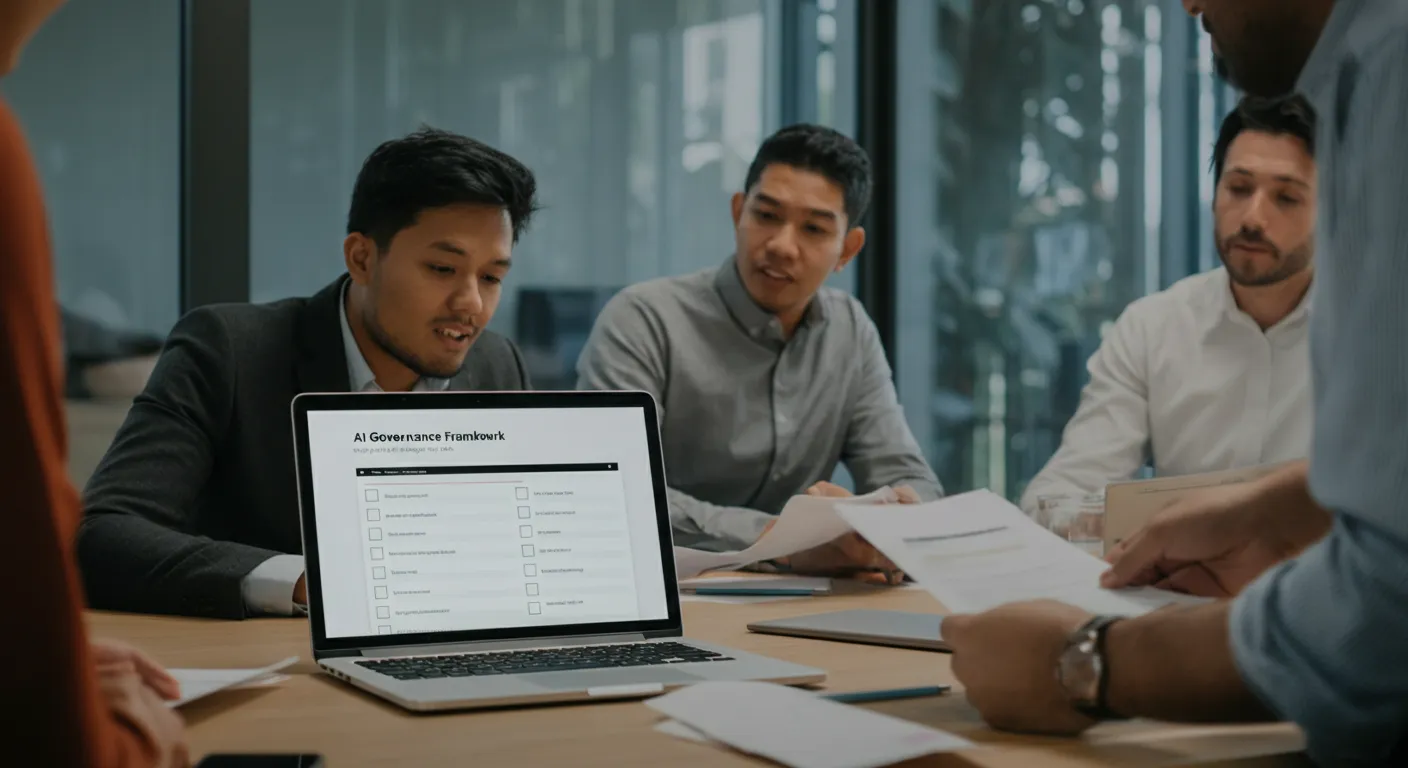
The short answer: Australian schools and RTOs need a formal AI governance framework that covers policy, staff readiness, data privacy compliance, and academic integrity before deploying generative AI tools. The Australian Framework for Generative AI in Schools provides the nationally recognised starting point, and Victorian education providers must also align with the Privacy Act 1988 and relevant departmental directives.
Generative AI has moved from curiosity to classroom reality faster than most education providers anticipated. Victorian schools and registered training organisations (RTOs) are now fielding questions from students using AI writing tools, teachers exploring AI-assisted lesson planning, and administrators wondering whether chatbots can handle enrolment queries. The challenge is not whether to use generative AI. The challenge is building an AI governance framework that keeps schools and RTOs compliant, fair, and operationally confident as they do so.
This article provides a practical, structured approach to AI governance for Australian education providers, with specific guidance for Victorian schools and RTOs on policy development, staff readiness, compliance obligations, and administrative automation opportunities.
What Is the AI Governance Framework Schools Australia Need?
An AI governance framework for schools and RTOs is a documented set of policies, procedures, roles, and review mechanisms that govern how artificial intelligence tools are selected, deployed, monitored, and retired within an educational organisation.
The nationally recognised foundation is the Australian Framework for Generative AI in Schools, developed under the auspices of the Education Ministers Meeting and published to guide all Australian jurisdictions. The framework identifies six core principles:
- Safety and wellbeing: AI must not expose students to harmful content or data risks.
- Equity and inclusion: AI tools must not disadvantage students based on background or ability.
- Transparency: Schools must be open with students and families about AI use.
- Privacy and data protection: Student data must be handled in line with Australian Privacy Principles.
- Academic integrity: AI must not undermine the validity of student assessment.
- Teacher agency: Educators retain professional judgement; AI supports rather than replaces them.
For RTOs, the Australian Skills Quality Authority (ASQA) adds a further layer. Under the Standards for Registered Training Organisations 2015, RTOs must ensure assessment practices are valid, reliable, flexible, and fair. Any AI tool involved in assessment design, marking support, or student records management must demonstrably support these standards, not undermine them.
A complete AI governance framework for schools in Australia goes beyond a single policy document. It includes:
- An approved AI tools register
- An acceptable use policy for staff and students
- An academic integrity addendum
- A data privacy impact assessment process
- A staff training roadmap
- An incident response procedure
- A scheduled review cycle
Building a Generative AI Policy for Schools in Victoria
For Victorian schools, the Department of Education has issued guidance on the use of AI tools that aligns with the national framework. Any generative AI policy for schools in Victoria should reference this guidance alongside the Privacy Act 1988 (Cth) and the Victorian Privacy and Data Protection Act 2014.
Core Components of a School AI Policy
A workable policy need not be lengthy. The most effective school AI policies are concise, plain-language documents that staff can actually apply in practice. At minimum, your policy should include:
Scope and definitions: Specify what counts as a generative AI tool (text generators, image creators, AI tutoring systems, AI-assisted marking tools) and who the policy applies to (staff, students, contractors, and volunteers).
Approved tools list: Maintain a live register of AI tools approved for use at your school or RTO. Any tool not on the register requires explicit approval before use. This prevents staff or students from defaulting to free consumer tools that may store data offshore.
Data sovereignty requirements: This is where many education providers fall short. If an AI tool processes student names, enrolment data, assessment results, or behavioural records, the tool must comply with the Australian Privacy Principles, particularly APP 8 on cross-border data disclosure. Tools hosted in Australia, such as NexAssist from Nexmira Solutions, ensure student data never leaves Australian data centres.
Academic integrity rules: Define clearly when students may use AI assistance, how use must be disclosed, and what constitutes a breach. Align these rules with VCAA or your RTO’s assessment specifications.
Incident response: Document the steps taken when an AI-related privacy incident, data breach, or academic integrity breach occurs. Include notification obligations under the Notifiable Data Breaches scheme.
Policy Template Checklist
| Policy Element | Included | Notes |
|---|---|---|
| Definition of generative AI tools | Yes/No | Cover text, image, audio, and code generators |
| Approved tools register | Yes/No | Review every six months |
| Student acceptable use rules | Yes/No | Age-appropriate language for secondary students |
| Staff acceptable use rules | Yes/No | Specific to lesson planning, marking, admin |
| Data privacy and hosting requirements | Yes/No | Must reference Australian Privacy Principles |
| Academic integrity standards | Yes/No | Aligned to VCAA or ASQA assessment rules |
| Incident response procedure | Yes/No | Reference NDB scheme notification timelines |
| Parent and community communication plan | Yes/No | Annual update recommended |
| Review schedule | Yes/No | Minimum annual; six-monthly during year one |
Staff Readiness Roadmap for AI Implementation in Education Providers
A policy document sitting unread on a shared drive accomplishes nothing. AI implementation for education providers in Melbourne and across Victoria requires a structured staff readiness programme that builds confidence, not anxiety.
Phase 1: Awareness (Weeks 1-4)
Begin with an all-staff session introducing the school’s AI governance framework and the national principles. The goal at this stage is not technical training. It is to establish a shared language and dispel common misconceptions, particularly the fear that AI will reduce teaching roles.
Key messages at this phase:
- AI is a tool, not a replacement for professional judgement.
- The school has a clear policy that protects students and staff.
- Experimentation is encouraged within the approved tools list.
Phase 2: Practical Skills (Weeks 5-10)
Run hands-on workshops focused on the specific AI tools your school has approved. Cover:
- Effective prompt construction for lesson planning and resource creation
- Identifying AI-generated student content (limitations and methods)
- Using AI for administrative tasks such as drafting communications and summarising meeting notes
- Data privacy hygiene: never entering identifiable student data into unapproved tools
Phase 3: Embedding and Review (Ongoing)
Assign AI governance champions within each faculty or department. These staff members are the first point of contact for colleagues with questions and provide feedback to leadership on what is working. Schedule a formal six-month review of both the policy and the training programme.
For RTOs specifically, training should also cover how AI tools intersect with ASQA compliance requirements. Staff involved in assessment must understand that AI-assisted marking or feedback tools require documented quality assurance processes to satisfy the Standards for RTOs 2015.
Nexmira’s AI consultancy services include staff readiness workshops and governance policy development specifically designed for Australian education providers. This is a practical path for schools and RTOs that lack internal AI expertise.
AI Governance Framework for RTOs: ASQA Compliance Considerations
RTOs face a distinct compliance environment compared to schools. The AI governance framework that schools in Australia use as a starting point must be adapted significantly for the RTO context.
ASQA’s regulatory approach centres on outcomes for students and the integrity of qualifications. When AI tools touch any part of the training and assessment cycle, RTOs must be able to demonstrate:
- Assessment validity: AI tools used in assessment design or feedback do not introduce bias or compromise validity.
- Record-keeping integrity: Student records, competency sign-offs, and completion data remain accurate and auditable.
- Trainer and assessor accountability: Human trainers retain professional responsibility for all assessment decisions, even where AI provides support.
- Student disclosure: Students are informed about which parts of their training experience involve AI tools.
RTOs should document each AI tool’s role in the training and assessment cycle as part of their existing quality management system. A simple AI tool impact assessment, completed for each approved tool, is sufficient for most RTOs. This document records what the tool does, what data it accesses, who approved it, and how its outputs are quality-checked.
Given the Privacy Act obligations and ASQA record-keeping standards, RTOs should prioritise AI tools hosted within Australia. For context on what privacy compliance obligations look like in practice, the Privacy Act AI compliance guidance on the Nexmira blog provides a clear checklist relevant to organisations processing personal data.
Administrative Workflow Automation Opportunities in Schools and RTOs
Beyond policy and compliance, AI implementation in education providers in Melbourne and across Victoria offers genuine productivity gains in administrative functions. This is often the fastest path to demonstrating AI value to school leadership and boards.
The following administrative tasks are well-suited to AI automation in education settings:
- Enrolment query handling: An AI-powered website chat assistant can answer prospective student questions about courses, fees, and dates around the clock, reducing front-office call volume significantly.
- Parent and student communications: AI drafting tools can reduce the time staff spend writing routine emails, newsletters, and SMS notifications by up to 60%.
- Timetabling and scheduling queries: AI assistants can handle common queries about room bookings, exam schedules, and term dates without staff involvement.
- Staff leave and HR processes: AI workflow tools can automate leave request routing, substitute teacher notifications, and onboarding document distribution.
- Professional development tracking: RTOs can use AI to automate trainer qualification tracking and generate compliance reports for ASQA audits.
Nexmira’s NexAssist private AI assistant is designed precisely for this kind of internal workflow automation. Because it is hosted in Microsoft’s Australian data centres, it meets the data sovereignty requirements that schools and RTOs must satisfy under the Australian Privacy Principles. Staff can use NexAssist to draft communications, summarise documents, and answer internal queries without their data ever leaving Australia.
For front-of-house automation, Nexmira’s Website Chat Assistant can handle prospective student and parent queries in real time, directing complex questions to staff only when necessary. This reduces administrative burden during peak enrolment periods without compromising the quality of service that families expect.
Building automation on top of a sound governance framework is the right sequence. Automation without governance creates risk. Governance without automation leaves efficiency gains on the table. For a broader view of how to sequence these steps, the Nexmira guide to building a generative AI strategy for Australian businesses provides a practical methodology that education providers can adapt.
Key Takeaways
- The Australian Framework for Generative AI in Schools provides the nationally recognised foundation for any school AI policy, covering safety, privacy, equity, and academic integrity.
- Victorian schools must align AI governance with the Privacy Act 1988, the Victorian Privacy and Data Protection Act 2014, and Department of Education directives.
- RTOs require additional governance steps specific to ASQA’s Standards for RTOs 2015, particularly around assessment validity and record-keeping.
- A complete AI governance framework for schools in Australia includes an approved tools register, acceptable use policies, data privacy requirements, academic integrity standards, and an incident response procedure.
- Staff readiness is a three-phase process: awareness, practical skills, and ongoing embedding with designated AI champions.
- Administrative automation (enrolment queries, communications, scheduling, HR) offers the fastest return on investment and is most effective when built on a sound governance foundation.
- Australian data sovereignty is not optional for education providers. Any AI tool processing student data must either be hosted in Australia or have contractual protections meeting APP 8 requirements.
- Nexmira Solutions provides Australia-hosted AI products and governance consultancy specifically suited to the compliance needs of Victorian schools and RTOs.
References
- Australian Framework for Generative AI in Schools - Australian Government Department of Education
- Standards for Registered Training Organisations (RTOs) 2015 - Australian Skills Quality Authority (ASQA)
- Australian Privacy Principles - Office of the Australian Information Commissioner (OAIC)
- Notifiable Data Breaches Scheme - Office of the Australian Information Commissioner (OAIC)

